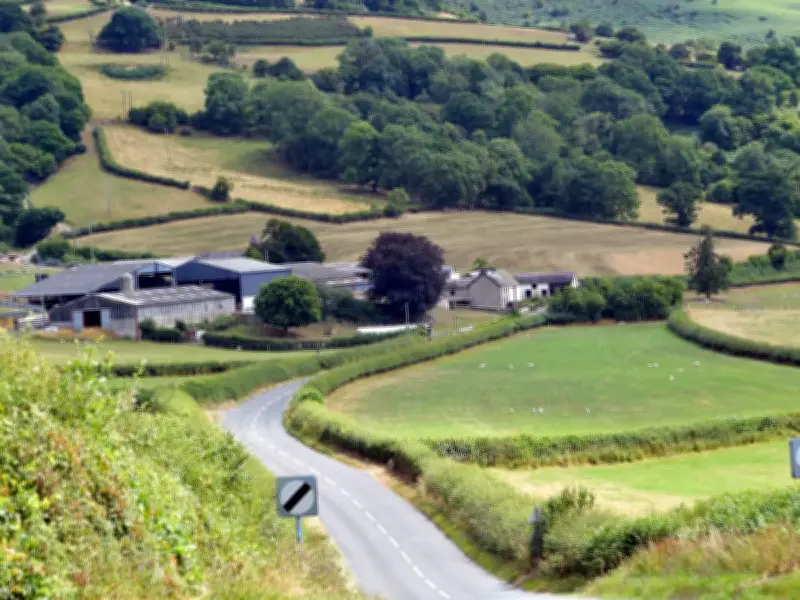
Professor Dylan Jones-Evans has called for a national rural growth and communities plan for Wales, arguing that rural areas must be seen as engines of economic potential rather than places requiring compensation. Writing in his latest column, he says that after attending the Green Man Festival in Crickhowell last month, he was prompted to consider the future of rural communities, which in Wales tends to focus almost immediately on farming, agricultural support, and the environment.
While agriculture remains economically, culturally and linguistically important to large parts of rural Wales, Jones-Evans warns that viewing rural Wales primarily through the prism of agriculture risks missing a bigger challenge: how to create the conditions for stronger economic growth beyond the main urban centres.
UK Government's rural report offers lessons for Wales
The UK Government's recent publication of its new Future of Rural England Report should be of considerable interest in Wales, Jones-Evans argues, not because an English strategy can simply be transplanted across the border, but because of how it frames the issue. Its central argument is that rural communities should be considered at the beginning of the policymaking process, not at the end. More importantly, rural policy is not simply about farming or the countryside but about economic growth, housing, skills, transport, infrastructure, health and connectivity - a distinction that matters enormously for Wales.

Large parts of north, mid and west Wales continue to face lower productivity, weaker transport links, limited access to high-value employment, housing pressures, demographic ageing and the gradual loss of important local services. Yet these areas are too often treated as though their economic role is somehow secondary to that of Cardiff, Newport and Swansea.
Rural Wales' economic assets and strengths
Jones-Evans stresses that rural Wales is not simply somewhere to preserve, subsidise or visit but is home to manufacturers, engineering companies, food producers, tourism businesses, professional services, technology firms and thousands of small businesses and entrepreneurs, many of which have the potential to grow well beyond their local markets.
Different parts of rural Wales possess significant economic assets that could underpin future growth. North-west Wales has strengths in energy, advanced manufacturing, food production, environmental science and digital innovation. Aberystwyth and the surrounding area have expertise in agri-tech, biosciences, veterinary research and earth observation. Pembrokeshire combines major energy opportunities with established engineering capability and port infrastructure, while Carmarthenshire and Ceredigion have strengths in food, tourism and the creative economy. Powys has opportunities across renewable energy, manufacturing, land management and festivals and events.
The question is not whether these assets exist, but whether they have ever been brought together into a coherent economic strategy. For too long, the response to weaker rural economies has been to treat them as places requiring compensation rather than transformation. While public money has rightly been used to protect essential services, support agriculture and sustain communities, that is very different from asking how these areas can generate more productive businesses, higher-value employment and greater investment.
Moving from managing weakness to creating growth
Jones-Evans argues that Wales needs to move from managing rural economic weakness to creating the conditions for rural economic growth, requiring a different approach from the one-size-fits-all policies that have characterised too much economic development in Wales. There is no single rural Welsh economy and therefore no single model should be imposed upon it. The economic opportunities in Gwynedd are not identical to those in Pembrokeshire, Ceredigion or Powys, and government should identify each place's particular assets and connect them to the finance, skills, infrastructure, expertise and business support required to help them grow.

He also highlights the problem of measuring economic success through national averages. Welsh productivity has lagged the UK average for decades, but the national figure hides enormous differences within Wales. The challenges facing a business in rural Ceredigion or Gwynedd can be fundamentally different from those facing a company in Cardiff, particularly when access to workers, transport, broadband, finance and markets are taken into account.
Policies designed around urban assumptions are too often rolled out nationally and then judged to have succeeded because a programme technically exists everywhere - which is not the same as being equally accessible or equally effective. For example, a transport policy based largely on passenger volumes may make little sense in communities with dispersed populations; a digital-first public service is of limited value where broadband and mobile connectivity remain unreliable; while a housing policy that fails to recognise the relationship between affordable homes and the ability of employers to recruit workers will inevitably constrain economic growth.
Rural proofing and the need for a national plan
This is why rural policy needs to sit at the heart of government, rather than being viewed primarily as the responsibility of the department responsible for farming and the environment. Economic development, skills, housing, transport, planning, energy and public services all shape the future of rural Wales. One of the most important lessons from the English report is that these issues need to be considered before policies are designed, rather than being 'rural proofed' after problems have emerged.
But rural proofing alone will not be enough. What Wales ultimately needs is a national rural growth and communities plan that places economic development at its heart and sets measurable objectives for productivity, business growth, housing, skills and connectivity, while allowing different parts of rural Wales to build on their own economic strengths.
For more than two decades, successive Welsh governments have rightly argued that the Welsh economy must become more productive, innovative and prosperous. That ambition, which has been seen in most economic strategies, cannot stop at the boundaries of our cities because rural Wales contains businesses, entrepreneurs, universities, natural resources and communities capable of making a much greater contribution to our economic future. What has been missing is a strategy that starts from that potential rather than assumes rural areas are principally places that need support.
The objective should ultimately be straightforward: no one should have to leave rural Wales simply to access economic opportunity, and a successful business should not be disadvantaged merely because of where it happens to be located. If such an ambition were finally adopted by those running this nation, that would represent a very different way of thinking about rural Wales, and it is long overdue.