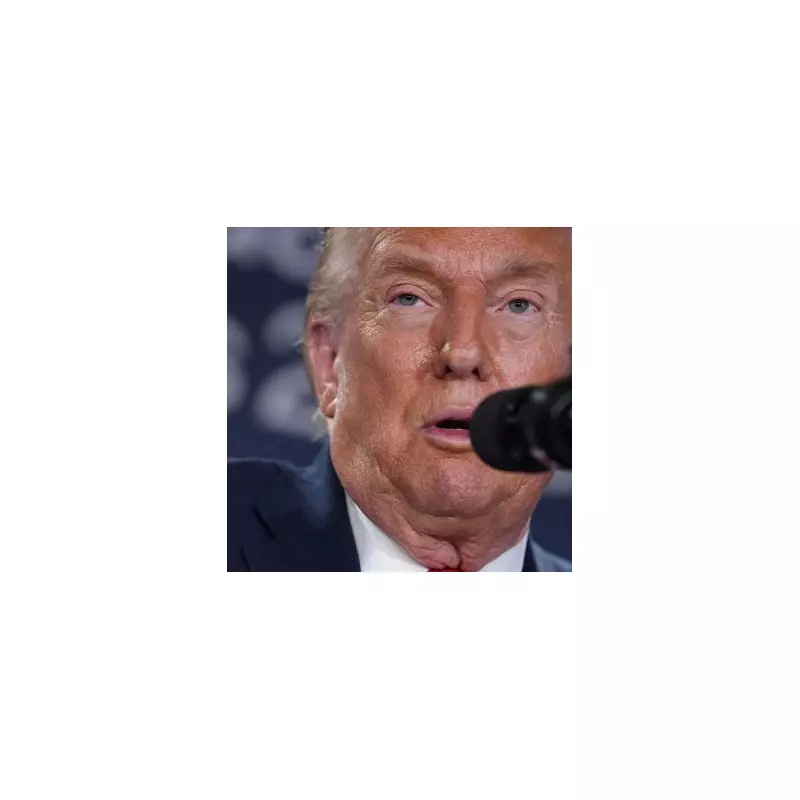
Global financial markets have experienced a significant rally following the announcement that former US President Donald Trump has withdrawn his tariff threat against several European nations, including the United Kingdom. The decision came after discussions with NATO leadership regarding potential arrangements concerning Greenland and the wider Arctic region.
Market Reaction to Trade Policy Shift
Stock markets around the world responded positively to the news, with notable gains recorded across major indices. Japan's Nikkei index climbed by nearly two percent, while South Korea's Kospi index surpassed the psychologically significant 5,000-point threshold for the first time in its history. The market movement reflects investor relief at the removal of immediate trade barriers that had been scheduled to take effect from February 1st.
Trump's Statement on Social Media
In a post on his Truth Social platform, Donald Trump explained his decision, stating: "Based upon a very productive meeting that I have had with the Secretary General of NATO, Mark Rutte, we have formed the framework of a future deal with respect to Greenland and, in fact, the entire Arctic Region. This solution, if consummated, will be a great one for the United States of America, and all NATO Nations."

He continued: "Based upon this understanding, I will not be imposing the Tariffs that were scheduled to go into effect on February 1st. Additional discussions are being held concerning The Golden Dome as it pertains to Greenland."
Financial Experts Weigh In
Immediate Relief with Lingering Concerns
Scott Gallacher, Director at Leicester-based financial planning firm Rowley Turton, commented: "Markets will be relieved the tariff threat has gone away, at least for now. But markets hate uncertainty, and with Donald Trump you get far too much of it. What's interesting is that even with the latest threats, markets mostly ignored him."
Broader Implications for Global Trade
Colette Mason, Author and AI Consultant at London-based Clever Clogs AI, offered a more analytical perspective: "The row over Greenland, and the renewed threat of tariffs, underlines just how brittle economic interdependence becomes when power is asserted through disruption rather than cooperation. What matters here is not Greenland itself, but the signal this sends about a deeper change in how the global political economy now operates."
She elaborated further: "Trade policy is no longer primarily about rules and reciprocity, but about leverage, pressure, and the willingness to inject uncertainty into allies' economies. Even though the tariffs were shelved after a loosely defined 'framework' deal, the mere fact they were contemplated against allies turns uncertainty itself into an economic cost."
"Once trade becomes a coercive instrument, trust between partners is weakened in ways that are hard to rebuild. The real vulnerability now lies less in the level of any given tariff, and more in the growing burden of structural unpredictability imposed on businesses, investors, and ultimately households."
Context and Background
The threatened tariffs would have affected eight European countries, creating potential disruption to established trade relationships. The connection between the Greenland discussions and trade policy represents a notable development in how geopolitical considerations are increasingly intertwined with economic decision-making. While markets have responded positively to the immediate removal of the tariff threat, financial experts suggest the underlying uncertainty created by such policy approaches may have longer-term consequences for international economic stability and business planning.