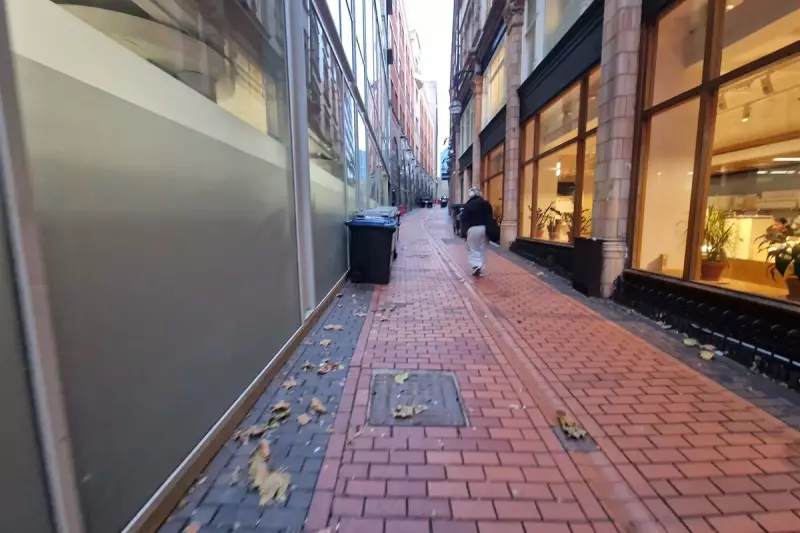
Have you ever heard the curious local phrase: ‘There is only one alley in Birmingham, and that is needless’? This saying refers to the historic Needless Alley, a narrow, lengthy passageway connecting New Street and Temple Row in the heart of the city.
The Literary Legend and Modern Reality
The enigmatic saying has captured local imagination, even inspiring West Midlands writer Natalie Barlow to pen a novel titled Needless Alley. Set in the 1930s, her story follows private enquiry agent William Garrett through Birmingham's bleak underworld.
However, a visit in December 2025 reveals a far more mundane scene. Today's stroll through the alley is less about noir mystery and more about urban utility. Visitors are likely to encounter large commercial rubbish skips and the rear entrances of various restaurants and bars. The atmosphere is relatively quiet, with the main footfall coming from commuters efficiently moving from point A to point B.
Theories Behind the 'Needless' Name
The origins of the alley's unusual name have been a source of speculation for years. Two primary theories have emerged to explain the legendary tale of Needless Alley.
The first theory suggests a historical link to the needle trade. It posits that the alley was originally named in honour of the needleworkers who once lived and worked on the street. According to this interpretation, the name should correctly be Needlers' Alley, which may have evolved or been misheard over time into its current form.
The second, and more salacious theory, speculates that the name is a pun rooted in the area's past. Some believe the street was once known for a high number of sex workers and brothels, thus earning the tongue-in-cheek moniker Needless Alley.
A Silent Witness to Birmingham's Past
Despite the intriguing theories, the alley's modern character makes its storied past difficult to visualise. It now functions as a practical service route, its legendary aura faded amidst the bins and delivery doors.
Yet, the alley remains a fascinating snippet of local lore. It stands as a silent witness to the layers of Birmingham's history, from its industrial and social past to its bustling commercial present. If streets could speak, Needless Alley would undoubtedly have captivating tales to tell, bridging the gap between Natalie Barlow's fictional 1930s and the city we walk through today.