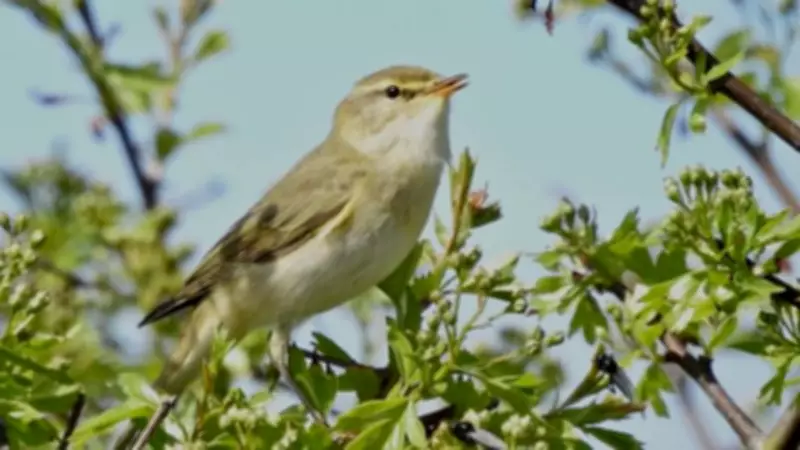
One of the pleasures of this time of year is the diversity of birdsong that rings out along the coastline, although many of our songsters are hardly Nightingale material. Summer visitors, having spent the winter in warmer sub-Saharan climes, bring a jumble of notes, churring, clicks and whistles to the dunes, which are relatively silent in the darker winter months.
This year, perhaps the most obvious songster on the dunes is the Common Whitethroat, with many birds holding territory in areas with isolated hawthorns. The closely related, but sadly ever-scarcer Lesser Whitethroat, favours similar habitat in the dunes but has a loud, dry rattling call.
Whitethroats will never win a prize for best melody, but their demented song is the soundtrack to the dunes this summer and is often delivered from an exposed perch or in distinctive song flights as they fly up over their territories then plane down with jerky movements, “singing” all the time, before dropping back into cover. A good view of a Whitethroat immediately reveals how this bird got its name.

Equally challenged in the melody department, Sedge and Reed Warblers tend to sing from cover, although the former will sit out on occasion, if the observer is quiet, patient and does not get too close. Another skulker is the Grasshopper Warbler, which prefers to sing from deep cover and can be heard from Birkdale to Hall Road, but is perhaps most abundant in the dunes around Hightown. Its buzzing song is unmistakable, although a minor electrical fault in overhead wires beside Green Sefton’s Ainsdale office is remarkably close to the Gropper’s song and has caught me out once or twice this spring.
Like the Lesser Whitethroat, Garden Warblers are becoming scarcer each year, so that their low-fi gabbling song which is delivered from deep cover is getting harder to hear. No such problem with the Blackcap, as their beautiful song of loud musical phrases rings out in any area with mature deciduous trees and scrub. They’re not called the “Northern Nightingale” for nothing.
Phylloscopus warblers provide an integral part of the summer soundtrack too, with the monotonous “zip-zalp” of Chiffchaffs audible in a range of habitats, while the beautiful descending cadence of Willow Warblers can be heard across the dune system. Although these two species are superficially similar, they sound very different (and the tail-pumping habit of a Chiffchaff is a real giveaway too).
The noisiest tunes of all come from the explosive notes of the Cetti’s Warbler, another secretive species which is happily colonising the borough and can be heard from Rimrose Valley and Crosby Coastal Park right up to Marshside RSPB reserve. This shouty critter will sing throughout the year but is most vocal now. The other species tend to sing less as the season draws on, so enjoy the wonderful sound of our migrant warblers while you can.
John works for Green Sefton, the Sefton Council service which brings together the Coast & Countryside, Parks & Greenspaces and Grounds Maintenance teams for a joined-up approach to the vital management, development and oversight of Sefton’s beautiful coastline, parks and green spaces. This column looks at the flora, fauna and history of the coastline, and the work that is carried out to protect it.