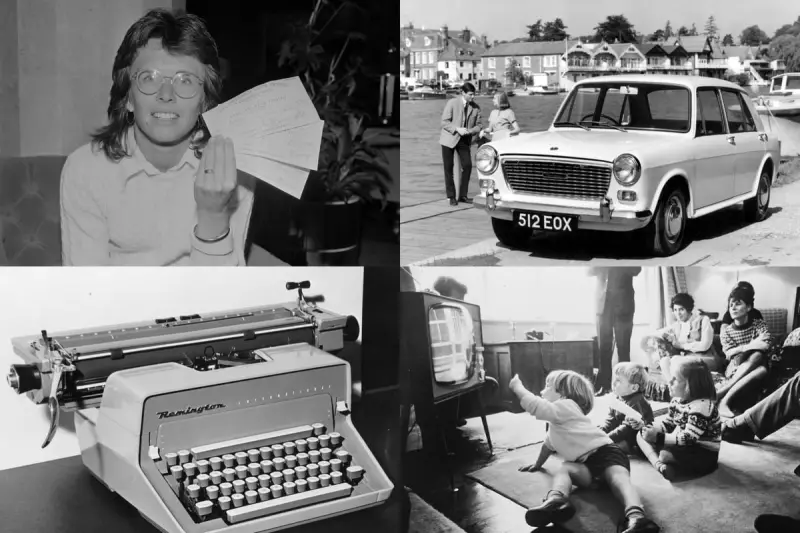
For those who grew up in the 1960s and 1970s, life moved at a different pace, a rhythm dictated by a collection of now-unfamiliar gadgets and objects. While modern technology offers seamless convenience, many commonplace items from that era would leave today's youth utterly perplexed. Here are seven popular things from the 60s and 70s that most people wouldn't know how to work today.
The Living Room Relics
Entertainment required a surprising amount of physical effort in the decades before streaming and remotes. The dial-operated television was a centrepiece in most homes, yet changing channels was a manual process. You had to get up from the sofa and turn a dial on the set itself to tune into one of the only three available channels. If the picture turned to static, the solution wasn't a reset button but a careful adjustment of the set-top 'rabbit ear' antenna.
Similarly, sharing holiday memories was a communal event centred around the slide projector. Families would gather in darkened rooms to watch a show of their photos. The process wasn't overly complex, but it required a specific trick: you had to remember to load each slide upside down to ensure the image would appear correctly on the screen.

On the Road and In the Office
Driving a car involved more than just turning a key. On a cold morning, starting the engine often required the use of a manual choke. This was a small lever on the dashboard that drivers would pull out to enrich the fuel mixture. A common sight was a clothes peg used to hold the choke in the open position. Beyond its practical use, many recall it doubling as a convenient hook for a handbag.
In the office, the soundtrack was the distinctive clickety-clack of the typewriter. While the keyboard layout is familiar, the machine demanded physical interaction. When a small bell dinged, signalling the end of a line, the typist had to manually return the carriage to begin a new one. There was no backspace key; errors were fixed with messy correction fluid or had to be typed over.
Everyday Analog Tasks
Communication and capturing moments were deliberate, patient activities. The rotary phone, with its satisfying spin-dial mechanism, made dialling a number a slow process. A phone number containing several 9s, which required the dial to travel almost a full circle, felt like it took an age to complete.
Photography was a costly and uncertain art with a 35mm film camera. With only 24 exposures on a typical roll, every shot was precious. There was no instant review or delete function. After taking a picture, you had to remember to wind the film on manually. Once the roll was finished, it had to be carefully rewound before being sent away for development, with a wait of several days to see if your photos were even successful.
Finally, financial transactions were often handled with a cheque book. Before the dominance of credit cards and mobile banking, cheques were a primary method of payment. For many young people today, the only cheques they encounter are birthday gifts from relatives, and the process of correctly filling one out for a bill or purchase is a complete mystery.
A Glimpse into a Bygone Era
These seven items highlight a world of tangible, hands-on technology. They required a specific, learned knowledge that has largely been rendered obsolete by digital automation. For the generation that grew up with them, these objects are nostalgic relics. For anyone younger, they are fascinating puzzles from a not-so-distant past, demonstrating just how rapidly daily life has been transformed.