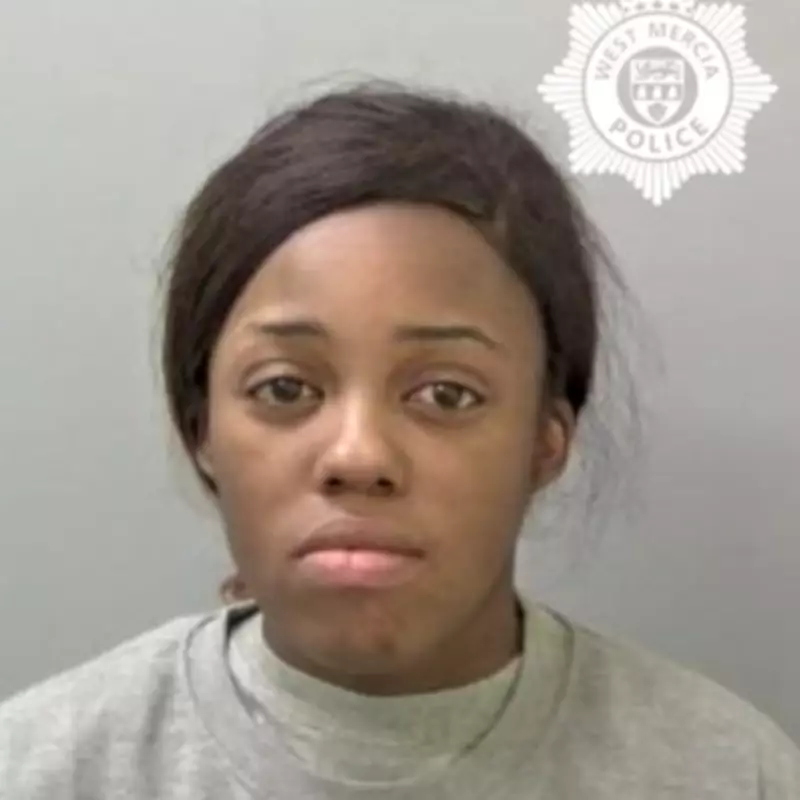
A mother who fractured her seven-week-old daughter's skull, causing injuries that contributed to her death from an infection more than two years later, has been found guilty of murder. Sarah Ngaba, 32, accepted that she caused "dreadful, life-shortening and life-limiting" head injuries to Eliza Ngaba, but denied murder, claiming she was instead guilty of infanticide.
A jury at Birmingham Crown Court took nine and a half hours over three days to find her guilty of Eliza's murder by a majority verdict of 10 to two. Trial judge Mrs Justice Brunner KC said Ngaba would be sentenced on June 12.
The trial heard Ngaba, formerly of Briarwood in Brookside, Telford, Shropshire, was previously convicted of causing grievous bodily harm to her child, who was left profoundly disabled by the assault. Ngaba was charged with murder after London-born Eliza died aged two in August 2022 from a respiratory infection, having been left vulnerable by the assault in November 2019.

Eliza's injuries were caused by forceful shaking "together with a very significant impact" to the head, causing a complex skull fracture. The court heard Ngaba took a bath and bought a lottery ticket from a shop before taking Eliza to hospital in a taxi on November 13, 2019.
Prosecution counsel Jonas Hankin KC said a witness who saw Eliza on a video call on the morning of the assault "could see that her body was shaking." The man advised Ngaba to take Eliza to hospital immediately but the defendant said she needed to have a bath and did not call an ambulance, the court heard.
Mr. Hankin added: "Instead, at 8.13am, she rang a taxi company. She was told that no taxi was available until 8.50am and that, if she needed to get to hospital sooner, she would have to make alternative arrangements. Despite that she settled for the taxi at 8.50am."
Doorbell footage caught Ngaba leaving her flat at 8.40am, jurors heard, and footage from a local supermarket at 8.59am showed her buying a lottery ticket and obtaining cashback. The taxi driver, Mr. Hankin said, arrived at 9.05am and described the defendant as being very calm and not seeming worried.
Of the defendant's behaviour at the hospital, Mr. Hankin said: "In triage and afterwards, staff described the defendant as annoyed, detached and concerned about housing rather than her baby's medical emergency."
The prosecutor continued: "The prosecution says that this sequence of events is important. Eliza was visibly shaking. The defendant was told to take her to A&E. An ambulance was suggested. She didn't call one. She chose to bathe and dress first, accepted a delayed taxi, went to a supermarket, bought a lottery ticket, travelled calmly to hospital, and did not even rush when she got there. That evidence is difficult to reconcile with the suggestion that the assault on Eliza was the product of an acute childbirth-caused disturbance of mind. It is more consistent with a lack of urgency, with detachment, self-concern, and a failure simply to prioritise her daughter's welfare."
After the verdict was returned, Mrs Justice Brunner told the jury: "Thank you for the great care you have very obviously taken in this case. You have taken your responsibility very seriously and have approached this difficult case with the attention it deserves. Each of you has done an important public duty." The judge also paid tribute to Eliza's foster parents, who showed "quiet dignity on every day of this trial," adding: "It is clear you gave her great love and care." She told Ngaba the sentence she would face must be one of life.