
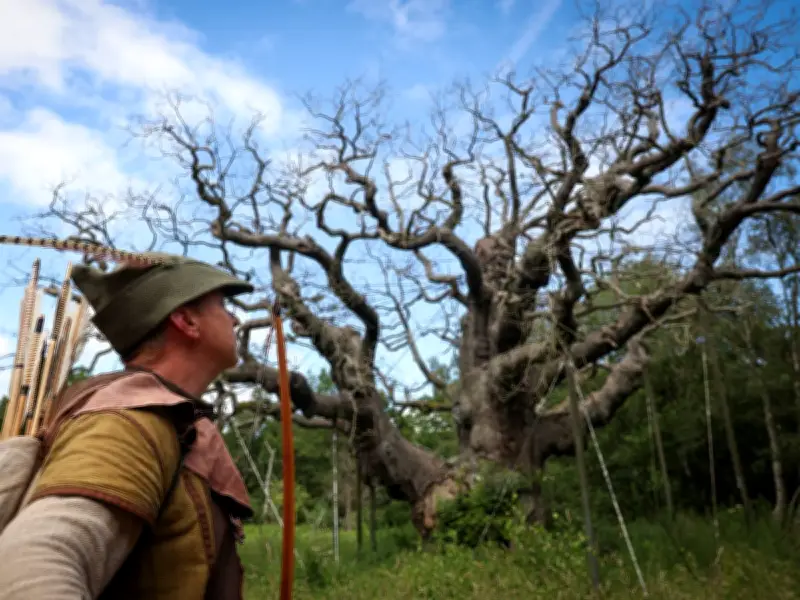
Nottinghamshire's legendary Major Oak tree has officially been confirmed dead following centuries as a global landmark synonymous with the Robin Hood tale. Specialists have determined that based upon all available scientific data, the ancient oak generated its final leaf burst in 2025 and the branches are now devoid of their verdant canopy this year.
Preservation efforts have been underway at the tree for more than a century, with that work gradually intensifying in recent years, and conservationists were compelled to refute speculation a couple of years ago that the tree had perished. However, those responsible for the historic landmark say they are now "gutted" to verify the death of the Major Oak after an estimated 1,000 years of existence.
Expert Reaction
"It is a moment of great sadness for me in the job that I have, but also as a visitor to Sherwood Forest," said Chloe Ryder, the RSPB's estate operations manager at Sherwood Forest. "I'm really gutted that the death of the Major Oak has happened in my lifetime."
Fabled outlaw Robin Hood was rumoured to have utilised the Major Oak as a refuge from the Sheriff of Nottingham, and this connection has attracted thousands to visit the tree annually for the past few centuries. This volume of tourism represents one of the principal factors that have led to the tree's demise, with visitors having compacted the earth surrounding the Major Oak until a barrier was erected around it by the council in the 1970s. Such human efforts to safeguard the tree, which included supports being installed as far back as 1904, are now believed by specialists to have arrived "too late" in the tree's existence, with some potentially having worsened matters.
Scientific Explanation
Dr Ed Pyne, from the Woodland Trust, explained: "What many people don't realise is that trees are theoretically immortal, they have these special cells underneath their bark that essentially stay young forever and that allows the tree to produce new branches and new shoots to adapt to stresses. A tree like the Major Oak, where it's had 200 years of tree tourism, that's caused a severe level of long-term compaction that's damaged the soil and that's made it more vulnerable to things like climate change and the extreme drought events that we've seen over the last few springs. If it wasn't for this long-standing historic damage to the soil, there's no reason that the Major Oak had to die this year. It could have potentially gone on for many more decades, if not centuries, but trees are subject to the laws and forces of nature."
Legal Protections and Legacy
Proposals have emerged regarding creating legal safeguards for trees such as the Major Oak following the unlawful felling of Northumberland's Sycamore Gap in 2023, which also had significant Robin Hood connections. Dr Pyne suggests such legal safeguards should also apply to deceased trees in acknowledgement of the crucial role they continue to fulfil beyond their lifespan, although the RSPB has confirmed that Sherwood Forest already benefits from robust legal protections.
Discussing the role it will continue to serve, Dr Pyne explained: "Although the Major Oak has passed into that stage beyond life, in terms of what it's doing for biodiversity, in terms of what it's doing for the ecosystem, it's still providing a home for hundreds of different species and some of them are amongst the rarest and most threatened in Europe." Bodies including the RSPB and the Woodland Trust maintain that lessons learned from the Major Oak will prove essential in safeguarding other ancient oaks throughout the nation.
Future of the Tree
Beyond this aspect of the tree's heritage, numerous saplings have been cultivated from it over the years, with one being planted in the garden of the US Ambassador's London residence in 2023. The tree itself will also remain standing for potentially hundreds of years more as a "living museum" and the Robin Hood legend will continue to attract visitors.
Robin Hood himself, also known as Robert Brackley from Notts Outdoors, was asked where he and his Merry Men would be hiding now, to which he responded: "When you know the forest as well as I do, we'll find somewhere, don't you worry." He continued: "We have visitors from all over the world visiting the tree, we have generations that come back again and again. I think its legacy will live on not just in the county, but across the world."
Visitor Reactions
Cheryl and Dennis Swan had travelled from Blackpool to see the Major Oak on the very day its death was confirmed, with the couple enjoying a week-long stay in the Sherwood Forest area. Mrs Swan, 69, remarked: "Dennis had said when we were approaching it that it looked a bit dead, so it's a good job that we've had our picture taken with it now." Her husband Mr Swan, 63, said: "Coming to see the Major Oak was probably the top of our list of things to do when we came here. Usually on these forest retreats we'd just chill, but we knew we had to make a special effort to come and see this."
The RSPB's Chloe Ryder commented: "What we'd like to see is that people value and respect these amazing natural wonders. Even in its death, I think that the Major Oak remains one of the most beautiful trees that you can see. We'll be periodically assessing the tree, as we do with our other ancients, and making sure that it remains this visible icon in the landscape for as long as it's possible. My wish for the Major Oak is that in my lifetime it still remains in this form and that we don't have to take any steps to reduce it for stability or safety. It could be decades, even centuries, before it fades away into its next existence of feeding the forest fauna."