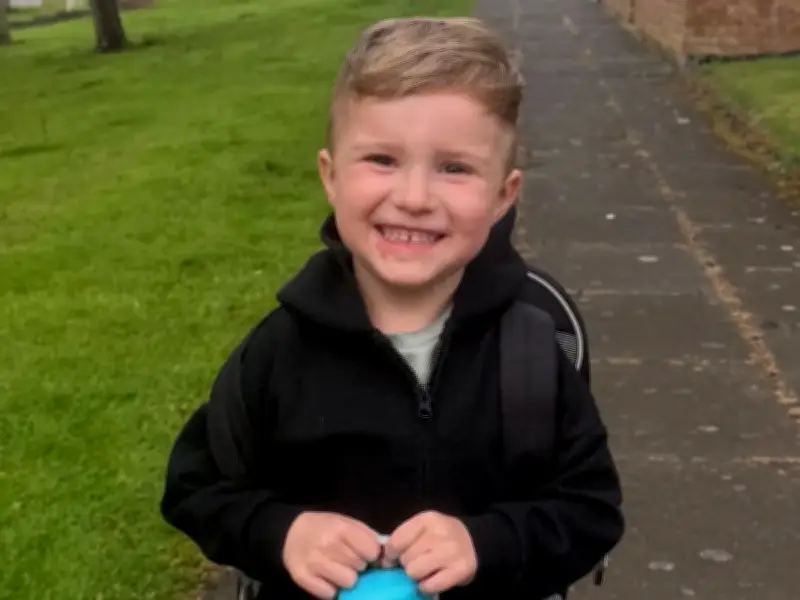
Laura Stuart's baby son Leyland, who was airlifted from Edinburgh to Birmingham Children's Hospital with end-stage liver disease, received a life-saving liver transplant after a seven-week battle. Now four, Leyland is thriving, and his mother has shared their story to encourage more people to join the NHS Organ Donation Register.
Discovery and rapid decline
Laura discovered her baby son had end-stage liver disease when she was 20 weeks pregnant. Little Leyland quickly deteriorated and had to be airlifted from Edinburgh to Birmingham Children's Hospital in need of a liver transplant, aged just one. She slept on a purple rocking chair at his bedside for seven weeks, whilst her husband Russell cared for their older daughter Isla, three, up in Scotland.
"I felt my baby was safe, nothing else mattered, I had to focus on Leyland," said Laura, who had gone to the GP because Leyland's stomach looked a bit swollen. "He went from being a healthy boy with a big belly to being severely ill so quickly, from nothing being wrong to a downward spiral. I thought they'd just say he would grow out of it but they said they didn't know how long he'd got."
Doctors discovered, in July 2023, that Leyland had been born with a rare condition called Alpha-1 Antitrypsin Deficiency (PiZZ type). Whilst he looked like a happy, healthy little boy, the damage to his liver was so severe that his only chance of survival was a liver transplant. Laura took him for assessments at Birmingham Children's Hospital as it is the top liver transplant specialist in the UK.
Emergency airlift to Birmingham
After returning home, his condition deteriorated and he ended up in intensive care at Edinburgh Hospital. On September 2, Leyland and his mum were airlifted to Birmingham Children's Hospital whilst his grandma followed in her car. By the time he got to Birmingham, his heart rate was low and he had a seizure.
"He lay on my mum all afternoon like a dead weight," said Laura. "The doctors said we need to get him through the night. I rang my husband and said you've got to come with Isla. I was so convinced he was going. But then he woke up screaming for his mum. He'd come back fighting."
Sadly, Leyland was so ill, he was suspended from the transplant list. His little body was just too weak to take a transplant. "I thought there would be another list for him, he was my child and I was fighting for him. Why was I being told no? But now I understand that it would have been a waste of the organ."
Devastatingly, Laura was the only family member to share the same blood type as Leyland but she couldn't be considered a live donor because of her pregnancy. Doctors battled to stabilise Leyland with blood transfusions, infusions, a Hickman line and total parenteral nutrition (TPN) in a bid to give him a chance of becoming strong enough for transplant.
The transplant and recovery
Seven long days later, Leyland was back on the transplant list and it wasn't long until a liver became available. Sadly, it was not viable so the family went back to waiting - at opposite ends of the country. Eventually, in November, they were able to go home and be together as a family again. By this time, Laura was 37 weeks pregnant and unable to fly so they had to make the long drive home by ambulance.
Baby Robin was born on November 26. Then, on December 6, Laura received a phone call from the transplant coordinator. They had a liver for Leyland and needed to get back to Birmingham. He was 18 months old. "It was a wonderful feeling and I was so relieved but I was also petrified," she said. "This was what we'd be waiting for, it was our goal. But when your goal comes, you realise you're not at the finishing line and he still had a massive surgery ahead."
Realising they were unlikely to be together for Christmas, Laura and Russell jumped on a commercial flight down to Birmingham with Leyland, leaving their nine-day-old baby and then four-year-old daughter with Laura's mum and dad. A member of the organ transplant team met them at Birmingham Airport and whisked them off to the children's hospital for the transplant.
Laura and Russell paced the waiting room for eight excruciating hours before receiving news that the transplant had gone ahead and that the surgeon wanted to see them. "We went into a side room and I saw a box of tissues and thought oh no," she said. "But they said everything went ok. I was so relieved I partially zoned out. They said the hard work really begins now and that we had a long road ahead for recovery."
Having been prepared for how he would look, Laura and Russell went to see Leyland, whose little body was covered in wires. "I didn't care about the wires, I just thought thank god to see him lying there and to see his heart beating. I'd been so scared and I was so thankful that he was alright." Mr Khalid Sharif was his surgeon and he was brilliant with kids, focusing on them, listening to them. He always made me feel so much better. What they had done with the transplant blows my mind. I'd been a donor for years but never given much notice to it. But there are kids, like Leyland, who would not be here without organ donation and that's the truth."
Leyland's donor family and life today
Laura has thought long and hard about Leyland's donor family ever since. Due to data protection, they are only allowed to know that it was a female aged 20 to 30 and that she had died due to a lack of oxygen in her brain. "I wrote a letter to her family, it took me three years to finish it and send it to them, I changed it at least a thousand times. I don't know who I am writing it to, the family of the person who gave my son his life. I don't know who she is and it's right that I cannot know anything about them. All I know is the worst day of their lives was the best one of mine. How can I ever make that sound nice? It's so bittersweet."
Five days after his transplant, Leyland was sitting up in a chair - and he was back home in Fyfe two weeks later. It meant the family were able to surprise Isla by being home just in time for Christmas. "Isla had made one simple wish, that her little brother would receive his new liver before Santa came. We set up a camera so we could film her walking into the house and finding us home. It was very emotional. Getting to hold Robin was amazing. She seemed so big and no longer like a newborn after just two weeks. She hadn't even had her health visitor check when I left her and now she was one month old."
The first three months after the transplant are crucial. He had to have 10 medications 10 times a day. As his immune system was suppressed, the family couldn't risk any germs so they isolated and kept Isla off nursery for three months. Leyland is now four and the family marks the anniversary of Leyland's donation every year.
Today, Leyland is thriving, and very proud of his scar. "He's wild, cheeky and so loving. He's rough and ready and loves golf. He wants to be the next PGA Masters Green Jacket. He's sporty and loves being outdoors and we encourage that as he will always be immunosuppressed and has to take anti-rejection medications which are very strong. He rolls about, jumps off everything, he is fiery and has no fear. And he dotes on his big sister and big brother, he thinks Leo is so cool at 13. People think he and Robin are twins because they are the same height and they look similar. She's three in November. We say he's like Wreck it Ralph because he's so boisterous. It's hard to think he was stuck in bed for seven weeks. I still wrap him up in cotton wool and keep him away from germs, I haven't been able to let that go yet. He's got a big scar on his belly and he tells people he got it from fighting a shark. We let him have that."
Laura has chosen to share her story to help raise awareness of the vital need for people to be on the organ donation register. "If you can no longer be here, if you go to heaven, or whatever you believe in, you can stop someone else going to that place. You can allow their loved ones more time, you can give a child another six months, a year or 30 years. Organ donation will always be a last resort when there is nothing that can be done, you can save someone's life, or even up to nine people's lives. You could make a million pounds but you'll never be able to match that."