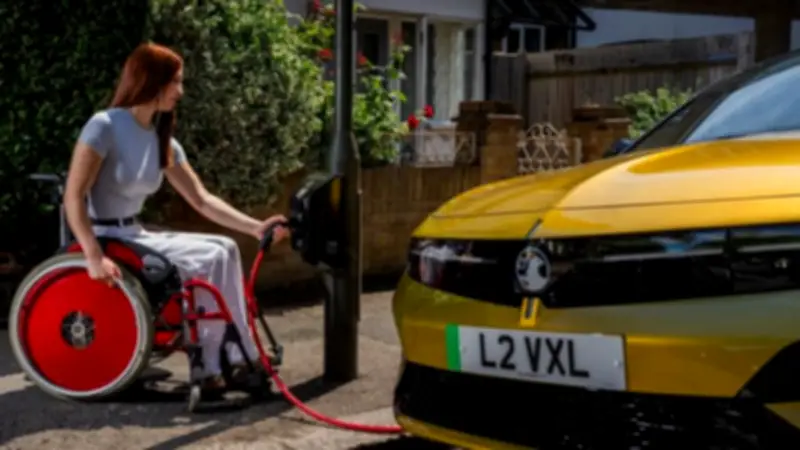
The number of on-street electric vehicle (EV) chargers designed for drivers with accessibility needs has doubled over the past year, yet three-quarters of councils still have no accessible chargers in place, according to a new study.
A Freedom of Information (FOI) request by Vauxhall Electric Streets of Britain has revealed that, despite a significant rise in accessible on-street charging provision, many councils still fail to offer any EV charging adapted for drivers with accessibility needs. The number of accessible on-street charge points situated within disabled parking bays has climbed to 245, up from 105 in 2025, though only 15% of on-street chargers are actually adapted for those with accessibility requirements.
Encouraging Progress, Yet Gaps Remain
Eurig Druce, managing director of Vauxhall, said: "It's encouraging to see the number of councils providing accessible on-street charging nearly double in the last year. This shows growing recognition of the importance of ensuring disabled drivers can access public charging infrastructure."

In response to the FOI request, 49 of the 194 councils stated that they provided on-street chargers that had either been 'specifically adapted for disabled drivers' or conformed to the British Standards Institution's PAS 1899:2022 accessible charging standard'. This marks a notable improvement on the 24 councils that reported the same last year, reports Jack Evans.
More Work Needed for Full Inclusion
Druce added: "Our latest research shows there is still more work to do. Three-quarters of councils still do not provide chargers that are specifically adapted for disabled drivers or conform to recognised accessibility standards. As more drivers make the switch to electric vehicles, we need to ensure all motorists can easily find and access charge points if we are to bring everyone on the UK's electrification journey."
The data underscores a persistent inequality in the rollout of EV infrastructure. While the doubling of accessible chargers is a positive step, the fact that only 15% of on-street chargers are adapted for accessibility needs means that many disabled drivers may still face significant barriers to using public charging.
Implications for Disabled Drivers
For disabled drivers, the lack of accessible charging can be a major obstacle to switching to electric vehicles. Without adequate provision, they may be unable to charge their vehicles conveniently, limiting their mobility and independence. The British Standards Institution's PAS 1899 standard provides a clear benchmark for what constitutes an accessible charger, yet many councils have not yet met this standard.
The Vauxhall study highlights the need for councils to prioritise accessibility in their EV infrastructure plans. As the UK pushes towards its net-zero targets, ensuring that all drivers, including those with disabilities, can benefit from the transition to electric vehicles is crucial.