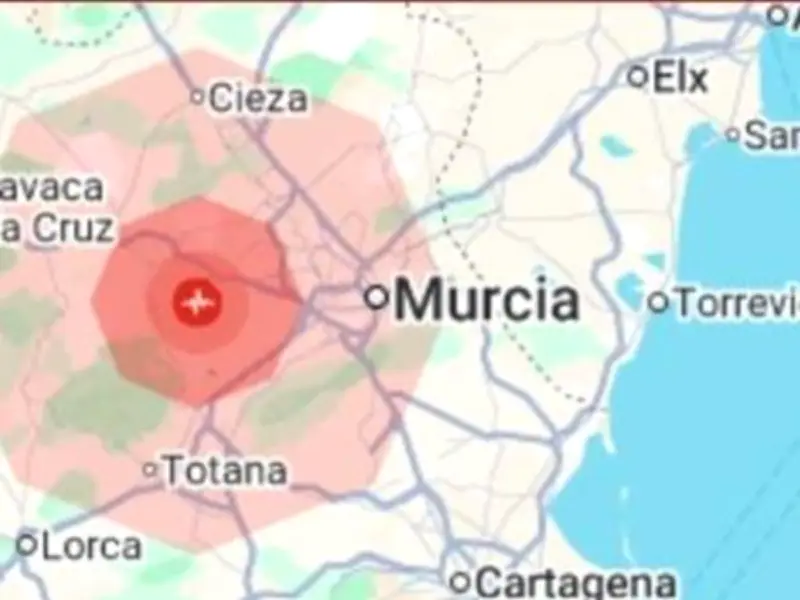
A 4.1 magnitude earthquake shook the Murcia region of southern Spain on Sunday, sending tremors through the popular British holiday destinations of Alicante and Benidorm. The quake, recorded by Spain's National Geographic Institute (IGN) at 11:59 am local time, was the strongest to hit the area in six months, according to officials.
Tremor details and epicentre
The earthquake was centred near the town of Librilla, at a depth of approximately 3 miles (5 kilometres), with the city of Murcia located around 18 miles from the epicentre. The tremor lasted for several seconds and was also felt in the neighbouring provinces of Alicante and Albacete, as well as in the coastal resort of Benidorm, a favourite spot for British tourists.
Emergency response and alerts
Emergency services were inundated with calls after the quake struck. The 112 Emergency Coordination Centre for the Region of Murcia reported on social media: "The 112 Emergency Coordination Centre for the Region of Murcia has received more than 80 calls (…) at various points in the region. So far, no personal or material damage has been reported."

The absence of damage came as a relief to residents and holidaymakers, though the sheer volume of calls highlighted the alarm caused by the sudden shaking. Local authorities remained on alert for aftershocks, which are common in the seismically active region.
Increased seismic activity in recent weeks
Spain's National Geographic Institute noted that the earthquake was preceded by seven smaller tremors in the days leading up to the event, part of a series of 21 seismic movements recorded in the past month. However, Sunday's quake far exceeded the previous strongest tremor, which registered magnitude 2.3 on June 3. The heightened activity has been closely monitored by scientists.
Regional context and historical precedents
The Murcia region is no stranger to earthquakes. In 2011, a devastating 5.2 magnitude earthquake struck the nearby town of Lorca, claiming 10 lives and forcing hundreds of residents to flee their homes. Numerous buildings crumbled in the town, located southwest of Alicante, and rows of vehicles were buried beneath debris. The local hospital was also evacuated during that disaster.
Today's earthquake also comes days after a significant 4.7 magnitude tremor hit Naples, Italy, on Friday, which damaged buildings and vehicles and left around 20 people injured. While the two events are not directly linked, they serve as a reminder of the seismic volatility across the Mediterranean region.
Why southern Spain experiences earthquakes
Southern Spain sits on the northern edge of the collision zone between the Eurasian and Nubian (African) tectonic plates. This boundary is pushing northward into Eurasia at a rate of roughly 4 to 5 millimetres per year, a slow but relentless process. The convergence, which played a key role in forming the Atlas Mountains of Morocco and the Alps of central Europe during earlier geological periods, is now expressed in southern Spain through the fault systems of the Betic Cordillera. This mountain range stretches from the Gibraltar Arc in the west through Malaga, Granada, Almeria and Murcia to the Mediterranean coastline, making the region prone to recurrent seismic activity.
Travel impact and advice
For the many British tourists currently holidaying in Alicante and Benidorm, the earthquake was likely a startling experience but, given the lack of damage, life has been able to continue as normal. The British Foreign Office has not issued any travel warnings in response to the tremor. Visitors are advised to follow local guidance and remain aware of safety procedures in the event of aftershocks.
Local authorities have pledged to continue monitoring the situation and will provide updates if any further significant seismic events occur. For now, the region appears to have escaped unscathed from what was the most powerful earthquake to hit Murcia in half a year.