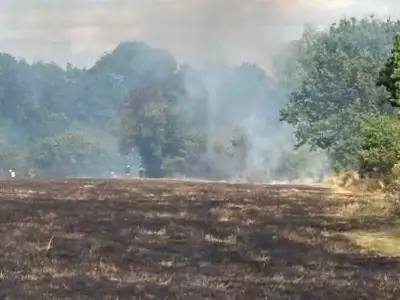
Sunday afternoon saw three separate wildfires break out across Birmingham, with fire crews battling blazes at Barr Beacon nature reserve, Kingfisher Park in Hay Mills, and Perry Hall Playing Fields in Perry Barr. The incidents came as the West Midlands, already placed in drought last week, continued to experience extremely dry conditions after months of little rainfall.
Barr Beacon nature reserve: eight crews deployed
West Midlands Fire Service said it was called to a large grassland fire at Barr Beacon nature reserve in Great Barr on Sunday afternoon. Eight fire crews were sent to tackle the blaze, and police were pictured blocking three entrances to the reserve as thick smoke rose into the sky.
Beacon Road was closed in both directions from the B4151 Beacon Hill to Bridle Lane, with motorists advised to find alternative routes. The fire service urged residents living nearby to keep windows and doors closed and to avoid the area where possible. Crews remained on the scene for several hours, working to contain the flames and prevent any further spread.

Hay Mills: Kingfisher Park blaze
A second large fire broke out at Kingfisher Park in Hay Mills, with video footage sent to Birmingham Live showing large plumes of smoke and fierce flames engulfing grassland. The fire is believed to have started around 4pm, and West Midlands Police officers were in the area directing people away from the danger zone.
Local residents watched as smoke billowed over the park, with the fire spreading rapidly through dry vegetation. There has been no immediate word on the cause of the blaze, but the dry conditions are likely to have played a significant role in its rapid growth.
Perry Barr: dramatic scenes at Perry Hall Playing Fields
The third wildfire took hold at Perry Hall Playing Fields off Perry Avenue, where six fire crews were dispatched to deal with the emergency. Flames tore through a large meadow area at around 12.45pm, and drone footage sent by a resident showed a huge section of grass completely blackened.
The park was busy with families attending the European Cycle Speedway 2026 tournament on the opposite side of the park. Spectators and families were forced to steer clear of the thick smoke as firefighters worked to bring the blaze under control. Members of the public were warned to avoid the area entirely, and crews remained dampening down hotspots for hours after the main fire was extinguished.
Drought and climate change fuel wildfire risk
The West Midlands was officially placed in drought last week, following months of significantly below-average rainfall. The dry spell has left vegetation tinder-dry, providing abundant fuel for fires and putting extra pressure on the region's fire service.
According to the government, most wildfires are started by human actions, but drought conditions increase the risk. Climate change projections suggest the UK will see conditions more favourable for larger and more severe wildfires in the future. In 2025, Scotland experienced the UK's first ever 'mega fire', which burned over 10,000 hectares in the Highlands.
"Increasingly, yes. Climate change is making our summers hotter and drier - ideal conditions for fire," the government said. "When landscapes experience several consecutive days of dry weather and little or no rain, plants and soils lose moisture faster than they can recover."
The government also warned: "Most wildfires start due to human activities and are a risk to communities, emergency services as well as increasing pressure on our health service. It takes very little vegetation (fuel) for a wildfire to start and it is important to follow wildfire prevention advice issued by the Fire and Rescue Service."
Health concerns over smoke inhalation
There is also growing concern over the health impact of smoke from these fires. Wildfire smoke contains a complex mixture of air pollutants, which vary depending on what is being burned and the nature of the fire. It is likely to include fine particles, carbon monoxide, nitrogen oxides and volatile organic compounds.

The fine particles are particularly worrying because they can penetrate deep into the lungs and even enter the bloodstream, potentially causing respiratory and cardiovascular illness. Residents in affected areas are advised to keep doors and windows closed, and to seek medical help if they experience breathing difficulties.
With the region still in drought and no significant rain forecast, firefighters remain on high alert. The public is urged to report any sign of smoke or fire immediately and to avoid activities that could inadvertently start a blaze.