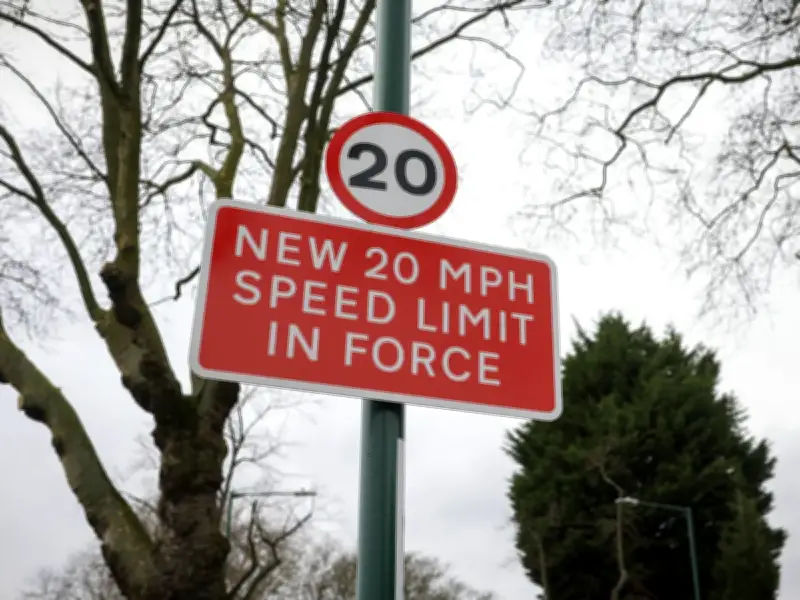
Birmingham City Council has confirmed that 20mph speed limits will become “standard on all local roads” as part of its new Local Plan, a major strategic document shaping the city’s development over the next two decades. The policy, which aims to end the dominance of cars around homes and schools, follows the council’s declaration of a road safety emergency in 2024 and its subsequent exploration of wider 20mph zones.
Local Plan sets out active travel vision
The Local Plan, a comprehensive blueprint adopted by the council – now run by a coalition including the Liberal Democrats and the Greens – outlines how the authority will support economic development and attract investment over the next 20 years. Within its sustainable transport chapter, the council states that “active travel” will be prioritised in local neighbourhoods.
“Walking and cycling will become how most people get around their locality most of the time,” the authority said. “Cars will no longer dominate street life around homes and schools. A limit of 20mph will be standard on all local roads. Residential neighbourhoods and local centres will be places where people are put first.”

Scope of 20mph rollout and exclusions
The document clarifies that “local roads” will not include A-class roads, which are described as some of the “most important and busiest metropolitan” routes within the region. However, all other roads – including B-class, C-class, and unclassified residential streets – will be subject to the 20mph limit.
The council said: “For all local roads (B and C class, and unclassified roads), 20mph speeds will continue to be implemented as part of a gradual rollout, through the delivery of the Birmingham Transport Plan.” The authority added: “There is a significant body of evidence which proves that reducing vehicular speed limits to 20mph on local roads has a disproportionately positive impact on the incidence of fatal and serious injuries from road traffic collisions.”
Support from council leadership
The Birmingham Transport Plan, adopted in 2021, already included ambitions to introduce 20mph limits in ‘local centres’, arguing that reducing car dominance would “improve air quality and reconnect communities”. Former transport boss Cllr Majid Mahmood said last year that slower speed limits on appropriate roads would reduce collisions and save lives.
“Approximately one third of the city’s roads are already subject to a 20mph speed limit,” he said in 2025. “We would like to expand the number of roads subject to this speed limit where appropriate and are currently exploring opportunities to carry this out.”
The council’s new leadership, which took office earlier this summer, has also voiced support for slower speeds on residential roads. Green councillor Julien Pritchard, deputy leader of the council, said earlier this year: “You also need enforcement as well. We’re talking residential roads, roads that are clearly not designed for through-traffic at speed. We want safer streets where children can play and it’s a nice environment to be in, rather than race tracks.”
Asked about claims of a ‘war on motorists’, Pritchard responded: “I think the war is on pedestrians and vulnerable road users – if there’s a war out there, it’s on some of the most vulnerable people using our roads. It’s not about punishing [motorists], it’s just about making streets safer for everybody.”
Next steps and recent measures
The Birmingham Liberal Democrats, who hold several key leadership positions, said speed reduction was a priority in their manifesto ahead of this year’s local elections. They said: “We should move to residential roads being 20mph, where there is local support and enforcement capability, along with other local speed reduction tools, such as road-narrowing and signage.”
Any plans to introduce more 20mph limits in Birmingham will first go through public consultation. The council has already taken other action, recently completing a major project to reduce speed limits from 40mph to 30mph on 27 roads in a bid to make streets “safer and more welcoming”.