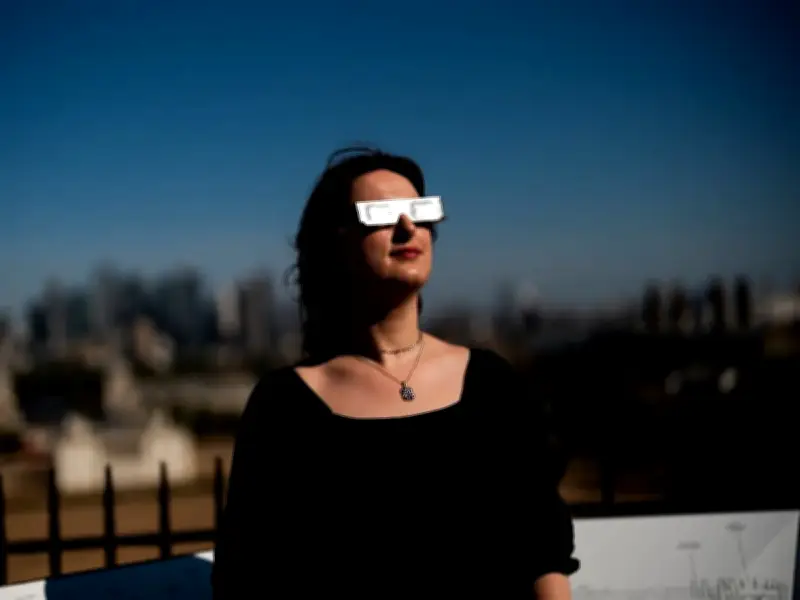
Major retailers and outlets across the UK have run out of solar eclipse glasses as shoppers travelled for miles to secure a pair ahead of Wednesday's solar eclipse, the best since the last century. Convenience shops, national parks and the Royal Greenwich Observatory have all exhausted their stock ahead of the event, which will be the UK's fullest for the next 54 years.
Record demand for eclipse glasses
The Royal Greenwich Observatory told the Press Association that they had sold approximately 15,000 pairs of eclipse glasses – a complete sellout – in the last month. They have also sold out tickets to their viewing event, but will offer a free viewing live stream on their website and YouTube.
A convenience shop in Whitechapel had to turn away dozens of shoppers hoping to get the specialist glasses, with its owner, Ali Raza, telling the Press Association that shoppers had been travelling far and wide to get a pair. Mr Raza, who owns the AM2PM shop, said: "On Sunday we had people coming from Surrey, Southend-on-Sea, yesterday night a lady came from Southampton, and loads of people have come from Birmingham as well. We're too busy."

He added: "Today I already sold 6,000 pairs. At 2.30am we had a delivery from Spain and by 9.30am we sold out everything."
Eclipse timing and visibility
More than 90% of the sun will be obscured by the moon between 6.17pm and 8.06pm on August 12 – the most it has been blocked in the UK since the total eclipse in 1999. In the UK, Devon, Cornwall and the westernmost parts of Pembrokeshire in Wales are set to see the eclipse at its fullest, with a range of 94% to 96% of the sun obscured by the moon.
Officials at Exmoor National Park, in north Devon, told the Press Association they have witnessed "large numbers" of visitors arriving to observe the eclipse. The park holds international dark sky reserve status, and a spokesperson confirmed they "couldn't keep up with demand" for eclipse glasses.
They said: "We got to a point where we couldn't get any more from our supplier in time and we don't need them again, not until 2081. As a national park centre, we've seen an increase in visitors specifically to our centre looking for those glasses and to ask us where would be the best places to go and look at it."
"We advise people to go up to high moorlands or coastal headlands, or Dunkery Beacon, the highest point on Exmoor, because you get an elevated view across to the west. We've sold over 300 pairs of glasses but we could've sold that twice over."
Viewing events and weather forecast
Exmoor will also host a now sold-out guided walk departing from the Hunters Inn pub, where participants will observe the spectacle from Highveer Point. At South Downs National Park, no fewer than five astronomy groups are staging events, with the eclipse followed by the annual Perseid meteor shower.
The Met Office confirmed that weather conditions across most of the country will be "more or less perfect" for eclipse viewing. A spokesperson told the Press Association: "With clear skies forecast across much of the UK, conditions should be more or less perfect for many to experience the partial solar eclipse. The north and west of the country are most likely to struggle with cloud cover when viewing the eclipse on Wednesday evening, particularly across Northern Ireland and western Scotland."
"The rest of Scotland and northern England may also see a good deal of high-level cloud, making skies rather hazy. The best opportunities for viewing the eclipse are likely to be south of a line from Aberystwyth to Lincoln."
Safety advice and alternatives
A planetarium astronomer at the observatory advised the Press Association that specialist glasses were essential for safely observing the eclipse, and that ordinary sunglasses are wholly inadequate. Imo Bell noted that solar telescopes – such as those on offer at the observatory's sold-out viewing event – or everyday household items with holes, like colanders, were viable methods for watching the eclipse, though eclipse glasses remain the preferred option.

She said: "You can use solar eclipse glasses, which are very, very different from sunglasses – they block out so much light that you can't see anything through them except the sun, because that's how much light they need to block for the damaging light of the sun to be safe to view. And if all else fails, you can project the image of the eclipse using a household item like a colander which has lots of holes in – point the colander towards the Sun with your back facing it, and in the shadow of the colander you'll be able to see the eclipse in the holes, which is really cool."
Specialists have cautioned that only dedicated solar eclipse glasses that are ISO 12312-2 certified for the safest eye protection should be used when viewing the eclipse. In the aftermath of the 1999 total solar eclipse, the Royal College of Ophthalmologists recorded approximately 70 cases of individuals suffering vision difficulties after watching the event. Remarkably, around 40% had observed it for under a minute.