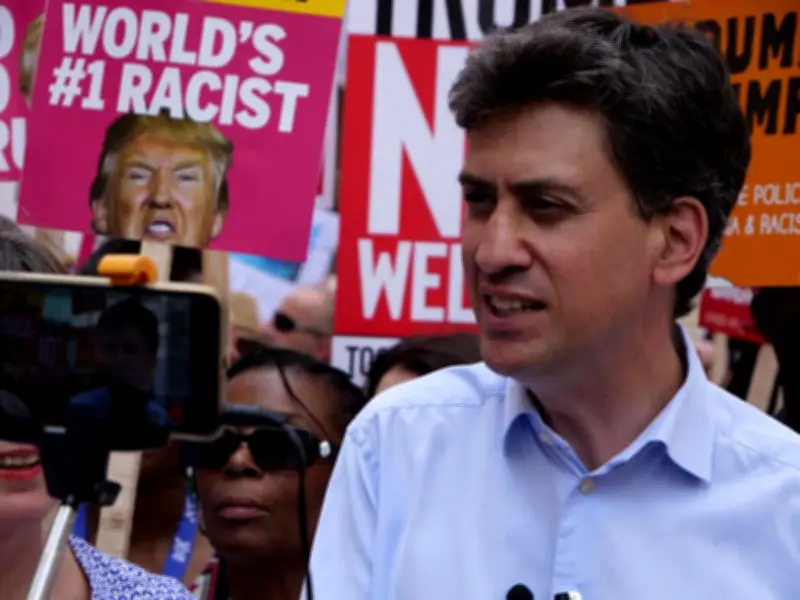
New Foreign Secretary Ed Miliband is likely to face an awkward first encounter with US President Donald Trump, given his history of outspoken criticism. Miliband, appointed by Prime Minister Andy Burnham, has previously described Trump as a 'racist, misogynistic self-confessed groper' and appeared at a 2018 Birmingham rally alongside anti-racism campaigner Salma Yaqoob, holding a banner declaring Trump 'the world's number one racist'.
Miliband's Past Comments and Rally Appearance
Images by photographer Adam Yosef show Miliband and Yaqoob at the July 13, 2018 national rally opposing Trump's planned UK visit. In an interview at the time, Miliband said: 'It is against the President of the United States and his values of racism, misogyny, no respect for democracy, respect for dictators.' He also later stated that Trump had 'lowered the bar for idiocy.'
Yaqoob, a former Respect Party founder and now a Green Party supporter, recalled standing alongside Miliband. 'I hope he holds on to that sentiment. I hope that the Ed Miliband who made strong comments about Trump's foreign policy, leadership and his racism and misogyny while in opposition will hold onto those principles in government.' She expressed no sympathy for the potentially awkward encounter, stating: 'Ed Miliband is an experienced politician. Lots of politicians have faced the dilemma before him, having spoken out about Trump publicly then having to do business with him. What he needs to do is demonstrate that he won't waver, and that he pursues policies that put British interests first, not those of Trump.'

Burnham's Foreign Policy Direction
Yaqoob suggested Prime Minister Burnham was 'well aware' of Miliband's past comments. 'I think Burnham has sent out clear messages with this appointment and in statements he has made about his foreign policy direction. One of the first things he did was to make a video distancing himself from Keir Starmer's position on Palestine and Israel.' She noted that Burnham appears to be reaching out to disillusioned Labour supporters who left over Gaza policy, while also reclaiming space from the Greens and progressive left. 'But while I would like to feel hopeful, the shift in tone has to be matched by actions. I am open minded but wait to be convinced.'
Continuity in Policy Despite Rhetoric
Following the conversation, Yaqoob highlighted that Burnham had 'quietly' authorised continued use of British military bases by the US for operations against Iran on his first day. 'Despite the change in tone, there hasn't been a corresponding change in policy. British territory, British infrastructure and British complicity continue to support a military campaign that has been credibly documented to have been responsible for bombing a girls' school and a strike on a children's cancer hospital. The real test of political change is not the language leaders use, but the decisions they make. On this critical issue the continuity with the previous approach is unmistakeable.'
US Ambassador's Response and Miliband's Pledge
US Ambassador to the UK Warren Stephens brushed off Miliband's past critique, suggesting his views had likely 'changed' since then. In his first words as Foreign Secretary, Miliband promised to nurture Britain's 'strong, enduring and essential alliance with the United States.'
Burnham's Apology on Gaza
In an interview before becoming PM, Burnham apologised for Labour's stance on Gaza, admitting the party 'didn't get it right.' He told the Guardian: 'I know many people feel that at the start of Israel's military action in Gaza my party didn't get it right and I am sorry about that. The response has too often not been good enough. We need to do better.' He added that the UK was too slow to call for a ceasefire and must strengthen its approach, but said it was for international courts to determine accountability for war crimes.