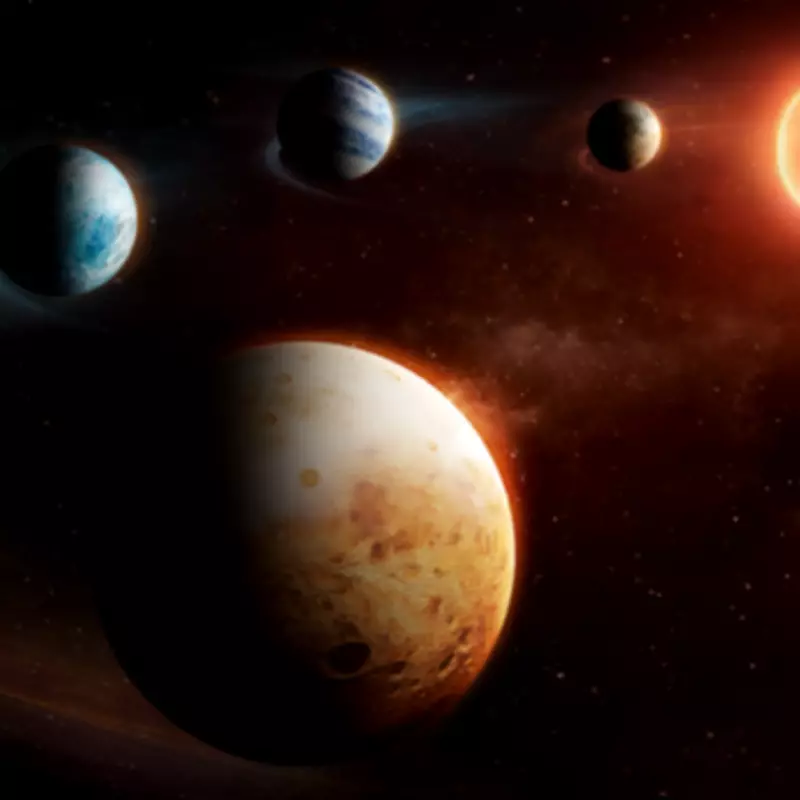
Birmingham Astronomers Discover 'Upside Down' Planetary System Defying Cosmic Laws
A team of Birmingham scientists has made a groundbreaking astronomical discovery that has turned established cosmic principles on their head. Hidden in the depths of space, approximately 116 light years from Earth, researchers have identified a peculiar "upside down" planetary system orbiting the distant red dwarf star LHS 1903, located on the outer rim of the Milky Way galaxy.
Challenging Universal Patterns
For centuries, astronomers have observed a consistent pattern throughout our solar system and beyond: inner planets closest to their host stars are typically rocky, while outer planets farther away develop as massive gas giants. This occurs because planets form from swirling gas and dust around stars, with radiation stripping away gaseous atmospheres from inner planets to leave solid cores, while cooler outer regions allow gas giants to accumulate.
This fundamental understanding of planetary formation has been considered a universal rule—until now. Using advanced European Space Agency telescope technology, the international research team, which includes prominent astronomers from the University of Birmingham, examined LHS 1903 and its four orbiting planets in unprecedented detail.
The Bizarre Configuration
To the astonishment of the global scientific community, LHS 1903 completely defies conventional expectations. While the planet closest to the star is rocky as anticipated, and the next two planets are gas worlds following the expected pattern, the outermost planet—the one farthest from its host star—is composed of solid rock.
This configuration creates what researchers describe as an "inside-out" system that contradicts everything previously understood about planetary formation. The discovery has been published in the prestigious scientific journal "Science," marking a significant milestone in astronomical research.
Scientific Reactions and Theories
Dr. Ancy Anna John, a key member of the Birmingham research team, expressed the profound significance of the finding: "It truly felt like standing at the forefront of scientific discovery. This system challenges our most fundamental assumptions about how planets form throughout the universe."
Dr. Thomas Wilson from the University of Warwick, who led the international team of astronomers, elaborated on the peculiar nature of the discovery: "This strange disorder makes it a unique inside-out system. Rocky planets don't usually form far away from their home star, on the outside of the gaseous worlds. We're looking at something that shouldn't exist according to our current models."
Investigating the Anomaly
The scientific community has launched an intensive investigation to understand this cosmic anomaly. Researchers have already ruled out the possibility that the rocky outer planet lost its atmosphere through a catastrophic collision with another celestial body.
Current evidence suggests the four planets did not form simultaneously but rather sequentially through a process called "inside-out planet formation." This staggered formation could explain why the outermost rocky planet developed in a completely different space environment than its planetary siblings.
Dr. Wilson provided further insight into this theory: "By the time this final outer planet formed, the system may have already run out of gas, which is considered vital for planet formation. Yet here is a small, rocky world, defying expectations. It seems that we have found first evidence for a planet that formed in a gas-depleted environment."
Implications for Astronomical Understanding
This remarkable discovery has placed a substantial question mark over scientists' understanding of planetary formation throughout the cosmos. The identification of a rocky planet forming in what should be gas giant territory suggests that planetary systems may develop through more diverse and complex processes than previously imagined.
The Birmingham-led research not only expands our knowledge of distant star systems but also prompts a reevaluation of fundamental astronomical principles that have guided scientific understanding for generations. As researchers continue to investigate LHS 1903 and similar systems, they may uncover entirely new pathways of planetary development that could reshape our comprehension of the universe's building blocks.