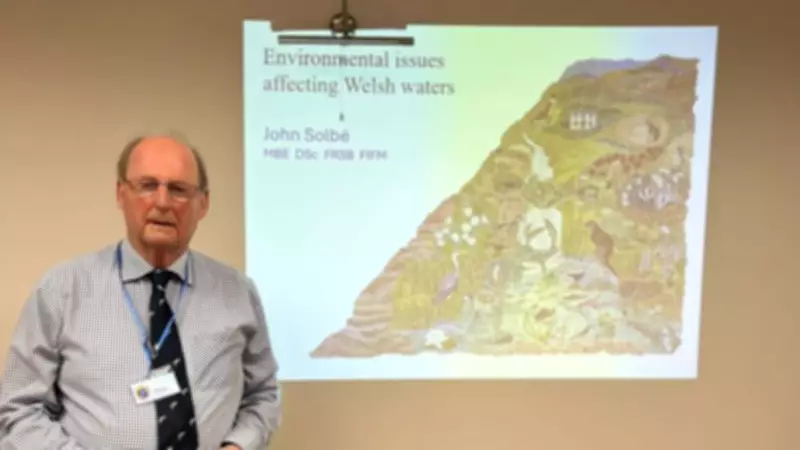
Members of the Denbigh and District Probus Club had an enjoyable May meeting, beginning with a wonderful meal at Tweedmill in St Asaph, followed by an informative talk titled "Environmental Issues Affecting Welsh Waters" delivered by Professor John Solbé DSc, MBE, FRSB, FIFM.
John Solbé is a retired biologist who graduated in 1963 and joined the Water Pollution Research Laboratory (DSIR) to study various aspects of environmental protection. He later became Principal Biologist and managed the ecotoxicology information service, representing the management of the Water Research Centre. In 1988, he joined Unilever to manage ecotoxicological research at Port Sunlight, and in 1995 moved his staff to a purpose-built site nearby with its own external facilities supported by extensive laboratories. He retired in 2001 but continued as a consultant to industry and government for the next 13 years.
John is a Steward of St Asaph Cathedral and served as Head Steward for over 12 years. He and his wife Rosie, also a Cardiff biologist, have been a driving force in the RSPB Conwy's Green Team, seeking to improve efficient use of electricity and water and recycling of wastes. They received the RSPB President's Award in 2010. John was awarded a DSc in 1992 by the CNAA and an MBE in 1995 for services to environmental safety. Both are Liverymen of the Worshipful Livery Company of Wales.

During his talk, John covered specific areas relevant to Wales but linked to broader issues such as polluted estuaries, acid rain, acid mine drainage, forestry and water resources, heavy metals pollution, oestrogen mimics from textile chemicals, animal husbandry causing water problems, eutrophication from farming, and low river flows that exacerbate problems from sewage effluents.
He categorised the problems for the Welsh environment under agriculture, industrial, coal-gas production, urbanisation, and centralised food processing, discussing their impact on air, land, and water, and exploring ongoing and potential solutions. The impact on residual environments and land conditions was illustrated by the historic extraction of copper ore at Mynydd Parys on Anglesey, where the very acidic land can sustain little more than heather, and similar mining activity on the Great Orme in Llandudno.
In terms of forestry, John explained that pine trees act as atmospheric scrubbers, bringing acid into water. He also discussed the sources of problems for the Atlantic salmon, describing their lifecycle, breeding cycle, and movement through river systems, as well as threats including heavy industry pollution particularly in estuaries, overfishing, soil erosion leading to siltation, sediment banks, concentration of prey, and strong organic wastes causing oxygen depletion. He explained how loss of access to spawning and nursery habitats can have a huge impact on salmon populations.
John highlighted that organisms in water can help determine the general health of a river and are useful indicators of pollution. Various interventions have been implemented with varying success, including bag limits and catch-and-return for anglers, construction of fish passes and refuges, and European directives such as the Urban Wastewater Treatment Directive and Forests and Water Guidelines. However, other solutions are yet to be activated, and more problems need addressing, including genetics, storm sewage, epidemics, long-range effects, climate change, and mysteries.
Club members thoroughly enjoyed the presentation and were pleased to receive access to further research information via John's page on independent.academia.edu/JohnSolbe.
The next Denbigh and District Probus Club meeting will be on Monday, June 1 at Tweedmill in St Asaph, when the speaker will be Peter Kirkpatrick, who will talk about the work of The Samaritans.
Denbigh and District Probus Club is a group of business or professional women and men either approaching or enjoying retirement or semi-retirement. New members are always warmly welcomed.
For further information, visit the club website at denbighprobus.com or contact stevetootell@gmail.com. Location: Denbighshire.