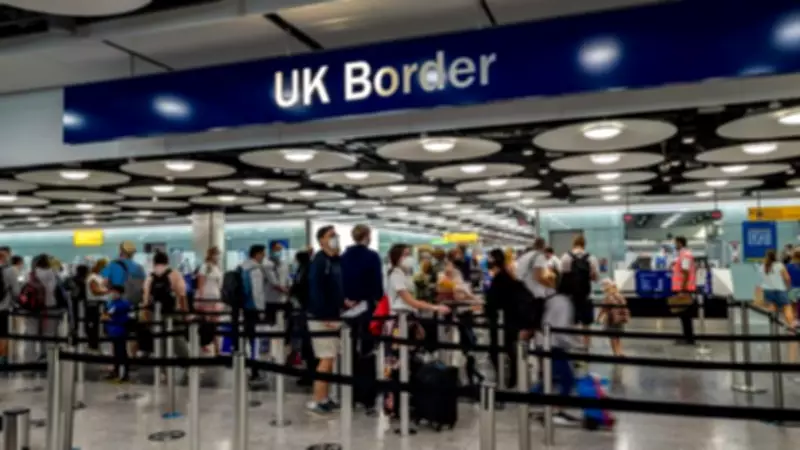
The number of people moving to the United Kingdom experienced a sharp decline last year, reaching its lowest level since the onset of the pandemic. Official statistics reveal a significant shift in border trends, with substantially fewer arrivals recorded over the 12-month period.
Net Migration Drops Below 200,000
This change marks the first time net migration has fallen below the 200,000 threshold since the initial Covid-19 outbreak. Newly released data helps clarify how travel and work patterns are shifting across the nation. Experts trace the current trajectory back to earlier moments, including the year ending March 2021, when the total stood at 132,000. That specific period was heavily influenced by health travel bans and the introduction of the post-Brexit points-based system.
The Office for National Statistics revealed that the ongoing decrease stemmed from fewer non-EU citizens arriving for employment. Around 813,000 people entered the country during 2025, while approximately 642,000 individuals chose to depart, reports Flora Thompson, Ian Jones and George Lithgow.

More British Citizens Leaving Than Returning
Interestingly, the data shows that more British citizens emigrated than returned, with 246,000 leaving compared to 110,000 coming home. A matching trend was seen for European citizens, with 118,000 departures against 76,000 arrivals.
Arrivals from outside the European Union remained higher, with 627,000 people relocating here and 278,000 moving away. Parallel Home Office data released on May 21 showed hotel asylum accommodation fell 35% to 20,885 by March.
Government Response
Ministers have promised to close all asylum hotels swiftly before the current Parliament ends, which must happen by July 2029. Leaders state these updated statistics show their strategy is working exactly as they intended.
Home Secretary Shabana Mahmood acknowledged "there is still work to do. That is why I am introducing a skills-based migration system that rewards contribution and ends Britain's reliance on cheap overseas workers."
Opposition Criticism
Opposition figures have pushed the Government to take much firmer action regarding these ongoing population movements. Shadow home secretary Chris Philp expressed concern over the volume of British citizens choosing to leave.
"Brits are leaving on a massive scale, and non-EU immigration remains far too high. Labour must go further and reform indefinite leave to remain before their hard-left flank forces them to abandon it altogether. We want a small number of highly skilled migrants and no low-skilled migration at all. But sadly, Labour do not have the backbone to do any of it."
At 171,000, long-term international net migration (immigration minus emigration) for the year ending December 2025 has nearly halved from the year ending December 2024 (331,000).
Campaigner Concerns
Campaigners welcomed the reduction in hotel usage but warned that those fleeing danger face limited legal pathways. Jon Featonby from the Refugee Council highlighted the need to maintain secure alternatives for families.
"A fair and functioning asylum system is one that restores public confidence while helping refugees rebuild their lives. Closing resettlement schemes and safe routes that have been a lifeline for those fleeing conflict and persecution in countries like Ukraine and Afghanistan, alongside harsh policies in the new Immigration Bill, will not fix what is broken. If the Government wants to continue to work towards ending deadly Channel crossings, it cannot ignore the desperate need for safe routes."