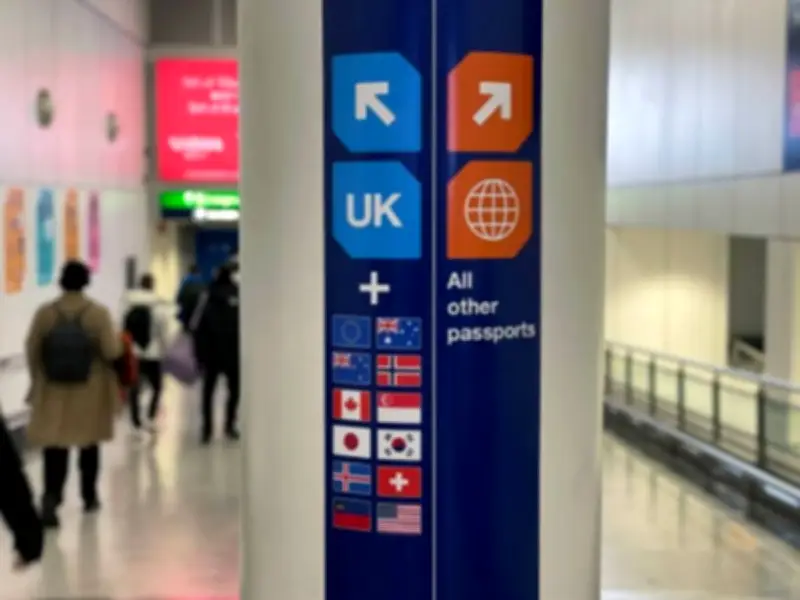
The European Union's new Entry and Exit System (EES), introduced earlier this year, has led to a significant flaw that could see thousands of British passport holders stopped at airports. In a recent case, a British woman was questioned by Romanian border police when trying to fly back to the UK from Cluj-Napoca in late May, after being confused with her identical twin sister.
How the EES Error Occurred
The woman was accused of being illegally in the Schengen zone because her departure from an earlier visit to Amsterdam in April 2026 had not been properly recorded. However, she had not been to Amsterdam at that time; her identical twin sister had. The Romanian authorities relied solely on facial recognition, which failed to distinguish between the twins.
Around 12,000 sets of twins are born in the UK every year, meaning thousands of people could face similar issues. The EES was designed to speed up border checks for UK tourists, but has instead caused long queues and confusion at popular destinations like Spain and Greece.
Expert Criticism of the System
Niovi Vavoula, chair in cyber policy at the University of Luxembourg, commented on the case: “From the account you sent me, it appears that the authorities are not well trained to distinguish between different processes and rely on facial images as the sole identification method. The fact they didn’t check the passport details in the EES, nor take into account that the EES is still fresh and there are various problems, shows what is called anchoring bias — when you rely on the first piece of evidence and disregard everything else.”
European Commission Response
When approached about the issue, a European Commission spokesperson said the Commission “does not comment on individual cases.” They added: “Member States are responsible for the data recorded in the EES, to which the Commission does not have access.” The spokesperson also stated: “When entering the Schengen area, travelers have to provide their biometric data (when crossing the EU external borders for the first time) as well as their passport data. This allows for the identification of each traveler separately. If a traveler is concerned about the processing of their data, they have the right to request rectification and completion of their personal data. In that case, they can reach out to the Member State’s competent authorities, either at the borders or by reaching out to the authorities.”
Impact on UK Travelers
The flaw highlights the risks of biometric-only identification systems, especially for identical twins. British passport holders are advised to carry additional identification and be prepared for potential questioning. The EES continues to face criticism for its implementation, with many travelers experiencing delays and errors at border crossings.