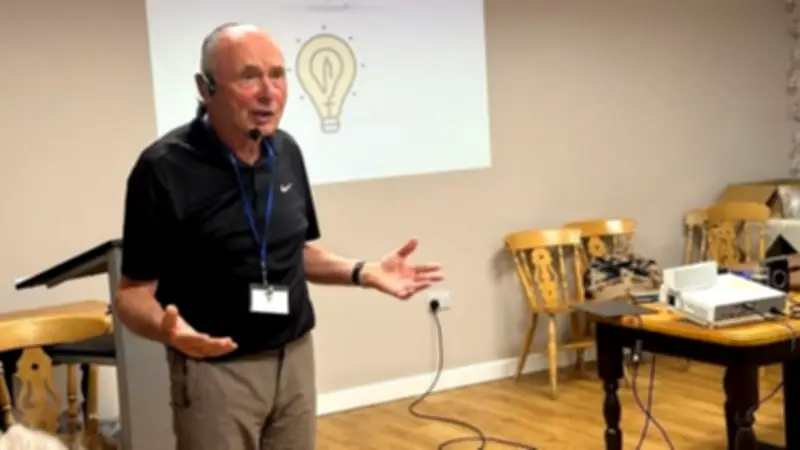
Members of the Denbigh and District Probus Club gathered for their June meeting, enjoying a wonderful meal at Tweedmill in St Asaph followed by an insightful talk titled "The Work of the Samaritans" presented by Peter Kirkpatrick.
Peter Kirkpatrick dedicated 34 years to the Royal Air Force, with 27 of those years spent climbing mountains for various reasons. This included 15 years with the RAF Mountain Rescue and 12 years training others in technical skills and personal development. From 1998 to 2020, he worked in employed, freelance, and voluntary roles supporting struggling teams, adults, and young people across the UK, as well as spending time in India and Oman. Following the pandemic, Peter joined the Samaritans and has recently achieved 1,000 shift hours. He admits that he is still learning, both about others and himself.
Peter, who now resides in Llanrwst, began by giving members a flavour of his RAF career after his childhood in Hull. After completing a one-year apprenticeship, he discovered the RAF Mountain Rescue service. He explained how the service began, initiated by Flight Lieutenant Doc Graham RAF in Llandwrog in 1943 when the RAF Mountain Rescue Service was formed due to the high number of aircraft crashes, with 150 to over 200 crashes in North Wales and 571 aircrew lost during World War II.
In 1966, there were six RAF mountain rescue teams in the UK, but currently only three remain. Alongside the RAF mountain rescue, a civilian system existed, initially formed in the Coniston area of the Lake District from farm workers, gillies, and forestry workers. The second civilian team was formed in the Ogwen Valley, Llanberis. During his time with mountain rescue, Peter experienced both fun and many sad moments, including the Lockerbie crash, a major incident during his RAF service.
Peter believes that mountain rescuers are often seen as heroes, but to him, the unsung heroes are single mothers, social workers, carers, and counsellors. Moreover, behind all the mountain rescue heroes he has known are partners and loved ones who accept when that person disappears in the middle of the night.
After leaving the RAF, Peter continued helping people and has been involved with the Samaritans for five years. He has been shocked by the desperation in some people's lives. UK registrations of suicides show 6,248 in 2020 and 7,147 in 2024, an increase of 14.3 per cent.
The Samaritans service was launched in the City of London in 1953 by Rev. Chad Varah, an English Anglican priest and social activist. There are currently 201 branches and 22,000 volunteers, the majority of whom are in the 50+ age group, with 60-70 per cent of volunteers being female. Branches are located in Bangor, Aberystwyth, and Rhyl in North Wales, with one also in Chester nearby and seven others around South Wales.
The Rhyl Samaritans branch has a team of 30 volunteers, including Peter. Many take on support roles in administration, maintenance, recruitment, awareness events, and fundraising to meet the branch's annual costs of £20,000. Listening-trained volunteers commit to one shift per week (3.5 hours) and one night shift per month. The work is driven by a simple belief: everyone has a story to tell, but not everyone has someone to tell it to. Through listening, volunteering, and fundraising, the team ensures that support remains available whenever needed.
Across the entire service in 2025, there was a call for help every 10 seconds, totalling 3.3 million calls. Suicidal behaviours were expressed in one in five contacts, and self-harm was discussed in one in 16 calls. Callers have a wide variety of issues linked to mental and physical health, relationship problems, and isolation and loneliness. Volunteers need to listen, offer short words of encouragement, ask open questions, and summarise to help callers clarify and reflect. They must "shut up and listen," remaining calm, non-judgemental, and curious, but not share their own stories or give advice, although they can signpost to other services when appropriate.
One of the biggest challenges for volunteers is the need to step back and not tell callers what to do, but simply listen. Training is provided to help volunteers develop these skills. The hope is that callers will feel listened to, have options for dealing with difficult situations, feel more hopeful about the future, be better able to cope, feel more understood and calmer, and feel less lonely or isolated. The service is entirely confidential, and while it cannot make a difference for every caller, there are countless occasions when just being there for someone helps them feel less alone and better able to face challenges.
If you would like to know more about volunteering with Samaritans, the best place to start is the Samaritans website. You can apply online and will be put in touch with your local branch, where they will explain the different volunteering roles and answer any questions.
The next Denbigh and District Probus Club meeting will be on Monday, July 6, 2026, at Tweedmill in St Asaph, when the speaker will be Barry Griffiths, who will talk about bees and beekeeping. Denbigh and District Probus Club is a group of business or professional women and men either approaching or enjoying retirement or semi-retirement. New members are always warmly welcomed. For further information, visit the club website or contact stevetootell@gmail.com.