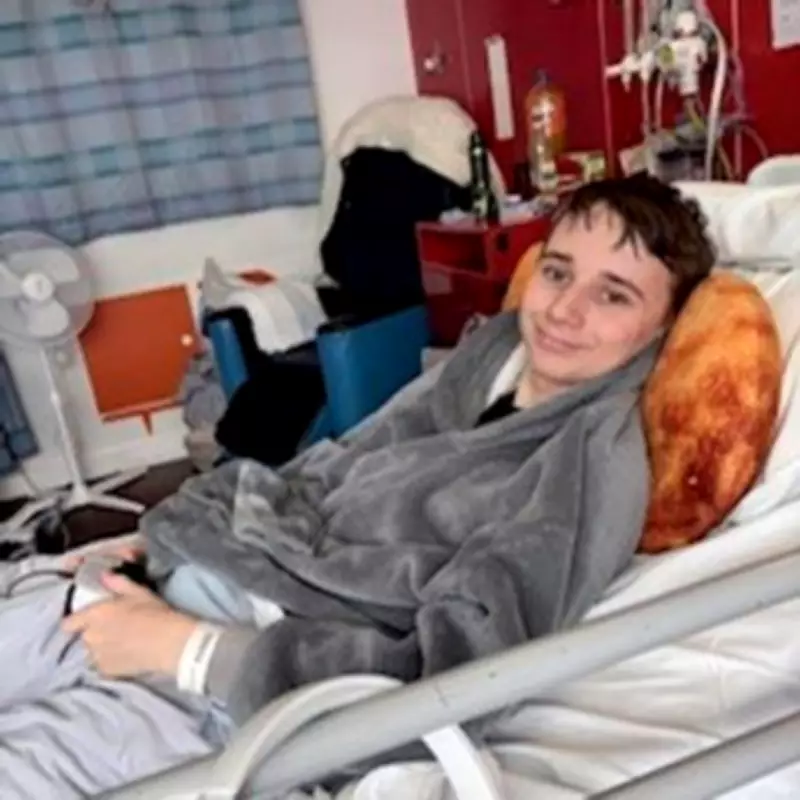
A teenager from the West Midlands who initially attributed his fatigue to the demands of a new college course was later diagnosed with blood cancer. Leo Sproson, 17, a student of electrical engineering, began experiencing unusual lethargy and developed large bruises on his body.
His mother, Jenna, grew concerned and took him to a doctor. A blood test revealed that Leo had acute myeloid leukaemia, a type of blood cancer. He was immediately admitted to Birmingham Children's Hospital, where he required a blood transfusion. Medical staff informed the family that Leo would need a stem cell transplant to have a chance at recovery.
Since no close family member was a suitable match, a search for a donor commenced. The family collaborated with DKMS UK, a blood cancer charity, to encourage people to register as potential stem cell donors. At a registration event in Bromsgrove, over 700 individuals came forward to join the donor register, a process that involves answering health questions and providing painless mouth swabs.
In December, the family received the joyful news that a compatible donor had been found. An anonymous individual from the donor register was identified as a match. Jenna expressed her gratitude: "We were blessed just before Christmas with the best gift any of us could have asked for. Not only were we told that Leo had achieved remission, but we also found out that he had a stem cell donor match, who could give him a chance to fully recover."
In February, Leo underwent the long-awaited transplant. Although he still needs time to fully recover, he has been discharged from the hospital and is now recuperating at home. Leo said: "It's been so great to be able to go home. I just feel so much better being in my own bed than in the hospital. I've been ill for a long time; it's amazing to think that I'm on the way to being well again, but it's weird too. I'm so grateful for the people who signed up as donors when they heard my story. Even though my donor could be from anywhere, the people who registered are already helping other people like me."
During Leo's illness, community members who had joined the stem cell register began contacting the family to share that they had been identified as potential matches for other patients worldwide. At least five individuals have undergone initial tests, offering hope to more families. Jenna added: "When we found out about the stem cell donor register, we just wanted to do everything we could to encourage more donors. We always said that if we could help to find just one match, even if it wasn't for Leo, if we've saved one other person, then that's good enough for us."
Bronagh Hughes, a spokesperson for DKMS, said: "For World Blood Cancer Day, hope starts in the West Midlands - we're calling on people across the region to get on the stem cell donor register. When a patient needs a stem cell transplant, most will not find a donor in their immediate family. Patients like Leo will rely on finding a stranger who is a compatible stem cell match, and who can offer them hope of a second chance at life. Joining the register means that you could offer that lifeline for someone in their time of greatest need. Most people will never be called to donate, but if you are, you have the potential to save someone's life, and DKMS will support you every step of the way."
New data from DKMS reveals that only 3.8% of people aged 16-55 in the West Midlands are registered as potential stem cell donors with DKMS, though this is above the UK average of 3.1%. As the UK marks World Blood Cancer Day on May 28, DKMS is urging people across the region to take action and join the stem cell donor register. Every 14 minutes, someone in the UK is diagnosed with blood cancer. For many patients, a stem cell transplant from a matching donor is their best or only chance of survival, yet only a small fraction of the UK population is currently registered. Leo and his family are supporting DKMS UK in encouraging people to order a free swab kit via the DKMS website, complete simple mouth swabs, and return them to be added to the register. Signing up is quick and easy: if you are aged 16-55 and in general good health, you are eligible. If matched, in nine out of ten cases donating is a simple, outpatient process similar to donating blood platelets, with support from DKMS throughout.