

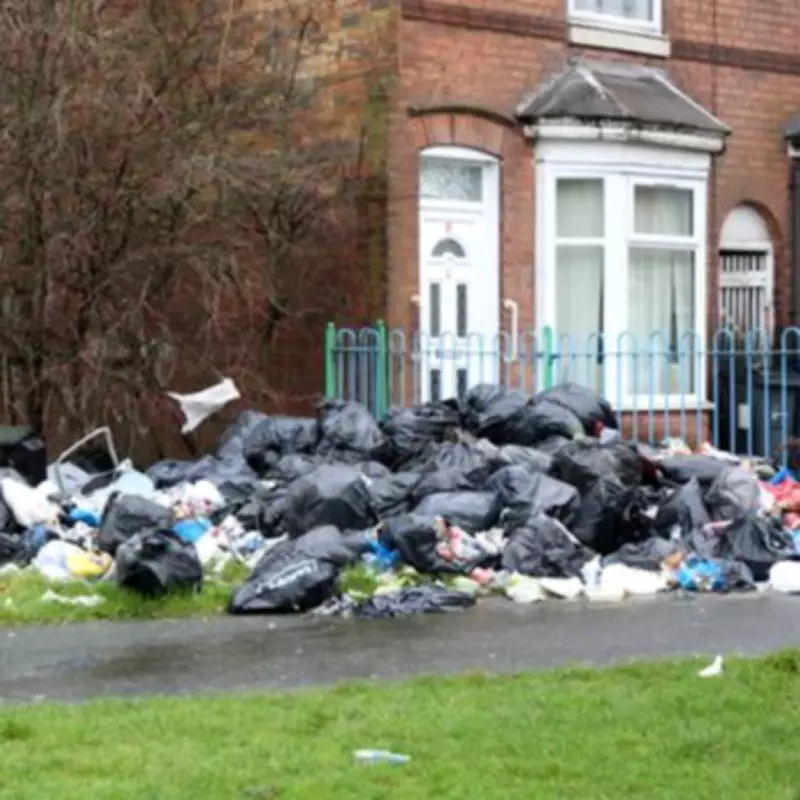
Birmingham Named Among Worst Fly-Tipping Hotspots in England
An interactive map has pinpointed the nation's fly-tipping hotspots, with Birmingham emerging as a top location for large-scale illegal dumping. In the year ending March 2025, local authorities across England dealt with 1.25 million fly-tipping incidents, marking a 9% increase from the previous year.
Costly Cleanup for Birmingham Taxpayers
Birmingham suffered significantly from industrial-scale fly-tipping, with 3,462 incidents involving tipper trucks or multiple waste dumps. These large-scale cleanups alone cost taxpayers in the city a staggering £2.10 million. This equates to approximately £1.78 per resident, highlighting the financial burden on the local community.
While London boroughs like Croydon and Camden reported the highest number of incidents per capita, Birmingham faced the most severe impact from substantial dumping operations. Croydon recorded 53,000 separate incidents, including 1,585 large-scale cases, whereas Camden had 36,126 incidents, or 167 per 1,000 residents.

National Fly-Tipping Trends and Enforcement
Nationally, nearly two-thirds (62%) of fly-tipping involved household waste, such as bin bags, old furniture, and carpets. Pavements and roads were the most common locations, accounting for 37% of cases. The size of dumps varied, with 31% being equivalent to a small van load and 27% the size of a car boot or less.
However, 52,000 cases involved tipper lorry loads or more, an 11% rise, costing English councils £19.26 million to clear. In response, authorities issued 572,000 enforcement actions, an 8% increase, and 69,000 fixed penalty notices, up 9%. Despite this, court fines dropped by 9% to 1,250, with their total value falling from £730,000 to £673,000.
New Measures to Combat Fly-Tipping
To tackle the issue, the Department for Environment, Food and Rural Affairs (Defra) has published new guidance to help councils seize and crush vehicles used for fly-tipping or repurpose them for cleanup operations. Councils are also encouraged to name and shame offenders on social media.
Defra Minister Mary Creagh stated, "We are empowering local authorities to clamp down on waste cowboys and restore pride in our local areas. I share the public’s fury at seeing our streets, parks and fields used as dumping grounds. Fly-tippers should know – if you use your van to trash our countryside, don’t be surprised when it ends up on the scrapheap."
Additionally, councils seized 139 vehicles last year, and the Environment Agency handled 98 incidents of large-scale illegal dumping. Outside London, Nottingham had the biggest rubbish problem, with 26,138 incidents, followed by Great Yarmouth and Boston in Lincolnshire.
Taxpayers in Leeds faced the next-highest bill from industrial-scale fly-tipping at £1.63 per person, with Wirral at £1.33. Defra has not released cleanup costs for overall incidents, focusing only on large-scale dumps. The interactive map allows residents to compare their area's fly-tipping rates with the rest of England, emphasizing the ongoing challenge of waste management.

